Idle Boxer
- 4.4
- Rating
- 100.00K
- Installs
- Free
- Price

 Analysis by App-foxy
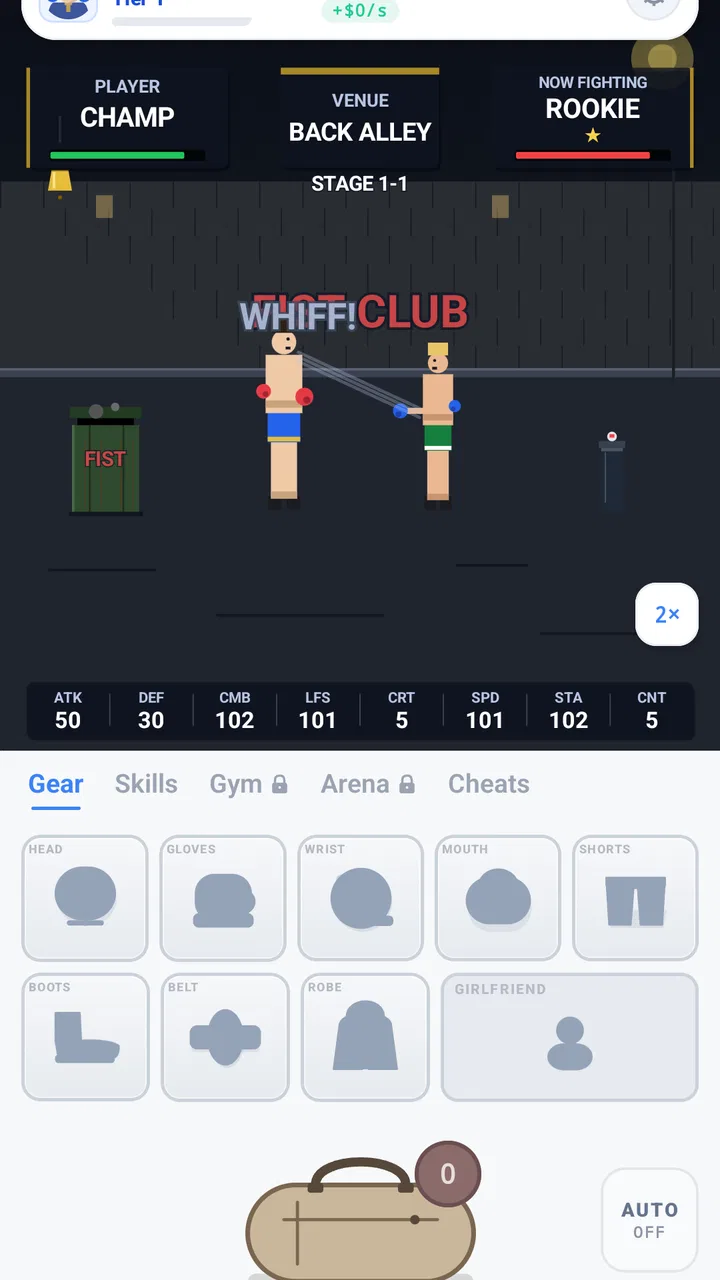
I approached Idle Boxer as the kind of game you open for a short break, make a few meaningful decisions, and leave running in the background of your day. Its central idea is easy to understand: build a boxer from early street-fighting roots toward the status of a boxing legend, then keep improving that fighter through an idle progression loop. What makes the concept appealing is the contrast between a sport that normally demands constant timing and control and a format designed around gradual, mostly hands-off advancement.
That makes it a very different experience from a traditional boxing game. I am not stepping into a ring and controlling every punch. Instead, I am checking progress, deciding where improvement matters most, and returning later to collect the results of earlier choices. The game is free to start, carries an Everyone 10+ content rating, and comes from Tap Nine. Its current version is 1.16.2, so the most useful way to judge it is as a lightweight, evolving simulation rather than as a complete replacement for a full fighting game.
How the current version feels to play
I use the current version as a quick check-in rather than a game that needs a dedicated session: I look at what has progressed, make one purposeful choice, and leave again. That rhythm makes it easier to spot whether the idle loop still feels satisfying or has become a habit without much payoff. Next, I’d focus on the small settings and routines that can make those visits more deliberate.
You May Also Like

 AccuWeather: Weather Radar
AccuWeather Review: A Quick, Clear Forecast for Everyday Decisions
For everyday plans, the best forecast is the one you can understand quickly. AccuWeather makes rain timing, radar, and local conditions easy to act on, with a few trade-offs.

 Hill Climb Racing
Why Hill Climb Racing Still Turns Crashes Into One More Run
A tiny car, a bumpy hill and one more upgrade: Hill Climb Racing keeps resurfacing because its simple chaos makes every near-miss feel personal.

 AliExpress - Shopping App
AliExpress Makes Global Shopping Feel Personal, but Shoppers Bear the Risk
AliExpress turns a global marketplace into a pocket-sized discovery engine. Its reach is useful, its shopping loop compelling, and its trade-offs easy to miss.

 Lords Mobile: Kingdom Wars
Lords Mobile Is a Kingdom-Building Routine, Not a Quick Match
A case-by-case verdict on the building, battles, device demands, and social commitments that make Lords Mobile rewarding for some players and exhausting for others.

 PDF Scanner app - TapScanner
TapScanner Makes Paperwork Easier to Capture, Check, and Share
TapScanner makes scanning with a phone feel less like a rescue operation and more like a dependable step in getting work done. Its capture tools are useful, though not flawless.

 Block Blast!
 Shows How Much a Puzzle Game Can Leave Out
A quiet grid game shows why puzzle players increasingly value instant clarity, repeatable skill and low-pressure play—and where the genre still needs to catch up.
More From Our News Desk
View All News


A boxing fantasy built around short visits
The strongest part of the design is its suitability for fragmented play. I can imagine opening it while waiting for a kettle to boil, checking it during a commute, or making a quick visit between longer activities. The game does not ask me to reserve a full evening for a match. Its appeal comes from watching a modest fighter gradually become more capable, then deciding how to use the next improvement rather than mastering a complicated control scheme.
That simplicity is also the first important trade-off. If I want the tension of reading an opponent, blocking at the right moment, and landing a combination under pressure, an idle boxer will feel deliberately limited. The satisfaction here comes from progression and planning, not from physical execution. I would recommend it to someone who enjoys management-style growth and the steady feeling of numbers moving forward. I would not choose it for a realistic boxing simulation or a competitive fighting experience.
What “idle” changes in a sports game
In a conventional boxing title, a strong round depends on what I do in the moment. In this game, the meaningful question is more often what I prepare before leaving it alone. That changes the rhythm completely. A short session is useful when I spend it improving the fighter, reviewing the next obstacle, and making sure the available resources are not sitting unused.
My practical advice is to avoid treating every return as a shopping trip. I get more value from first identifying the upgrade that removes the biggest current slowdown, then saving enough resources to make that improvement rather than scattering small purchases across several areas. In an idle game, a slightly stronger long-term choice can matter more than an immediately visible but minor boost.
Progression is the real attraction
The store summary frames the journey as a move from street fighter to boxing legend, and that gives the game a clear direction even when the moment-to-moment activity is restrained. I like progression systems that make early improvement feel visible, and this concept naturally supports that: a weak starting fighter has room to grow, while later stages provide a reason to keep checking in.
The danger is that idle progression can become routine. Once the initial novelty fades, the game needs each decision to feel worthwhile. If I am only tapping the same upgrade button without making trade-offs, the experience becomes background decoration. The best way to approach it is as a small daily management habit, not as a game that must constantly surprise me.
Who will enjoy the loop most
This is a good fit for players who like simulation games but do not want a complicated interface. It should also suit people who enjoy watching a character develop over time, especially when they prefer short sessions to long campaigns. Someone moving between work, study, and household tasks may appreciate a game that can be checked without demanding uninterrupted attention.
It is less suitable for players who measure value by depth of combat mechanics. If your favorite part of boxing games is controlling footwork, timing counters, or learning an opponent’s patterns, the idle format removes exactly those elements. I would also skip it if you dislike waiting-based progression or if you want every action to produce an immediate, skill-based result.
How I would use it during an ordinary day
My preferred routine would be simple. I would begin with a short morning check, spend available resources on the upgrade that improves the next stage of progress, and close the game rather than lingering without a purpose. Later, I would return during a natural pause, collect what has accumulated, and decide whether the next upgrade is worth saving for.
This approach avoids one of the common problems with idle games: opening them repeatedly without a clear decision. The game works better when each visit has a job. One visit can be for collecting progress, another for preparing a stronger build, and another for checking whether the current path is still efficient. That gives the simple loop a little more structure.
The free entry point and spending pressure
Idle Boxer is free to download, which makes it easy to test whether the format suits me before committing time. The game includes in-app purchases ranging from $4.99 to $99.99 per item. That broad range is worth keeping in mind because idle progression and optional spending naturally sit close together: a player who wants faster advancement may feel tempted to pay, while a patient player can approach the game more slowly.
I would set a personal rule before playing. I would first decide whether the ordinary progression is enjoyable on its own, then treat any purchase as a convenience rather than as a requirement for having fun. The most expensive option is especially easy to justify emotionally when progress slows, so it is better to judge the game during normal play before opening the purchase screen.
What the rating and audience suggest
The Everyone 10+ rating places it in a broad audience rather than an adult-only niche. In practical terms, I would still encourage parents to look at the game themselves before handing it to a younger player, especially because the boxing theme and optional purchases may matter differently from one household to another.
For adults, the rating is less important than the play style. The real question is whether a gradual simulation loop feels relaxing or repetitive. A younger player may enjoy the idea of building a champion, while an experienced action player may find the lack of direct ring control too passive.
Where it sits beside other boxing and simulation games
Compared with a traditional boxing game, this one trades physical skill for accessibility. I do not need to learn a control layout or react to an opponent in real time. Compared with a deeper management simulator, it appears easier to approach and better suited to short checks, though that also means I should not expect the same level of strategic complexity as a detailed sports-management title.
Its closest alternative is not necessarily another boxing game. It may compete more directly with other idle progression games that use different themes. The boxing setting gives the growth loop a stronger identity than a completely abstract simulator, but the underlying appeal remains the same: return, improve, wait, and decide what to do next. If I already enjoy that structure, the theme can make it more engaging. If I dislike idle mechanics in general, the boxing presentation probably will not change my mind.
What the current release tells me about the product
The current version, 1.16.2, shows that the game has moved beyond an initial launch build and is being presented as an actively maintained product. That is useful context for existing players: the experience should be judged as something that may continue to be refined rather than as a fixed, finished package. The release date is Apr 24, 2026, so I would keep expectations realistic when evaluating how mature the overall progression feels.
I see the version number as a reason to pay attention to future updates, not as proof that every possible weakness has been solved. A later build can improve balance, smooth rough edges, or add more reasons to return, but the current version still needs to stand on its own. For a new player, that means there is little benefit in waiting for an imagined future unless the present loop already sounds appealing.
What changes mean for returning players
For someone who has already invested time, the main concern is continuity. A version update can be encouraging when it keeps the core routine familiar while making progression clearer or more satisfying. It can also be disruptive if a player has built habits around an earlier balance. I would approach the current release by reassessing which upgrades now provide the best value rather than assuming an old routine remains optimal.
A useful returning-player habit is to compare outcomes over several visits instead of judging a change after one collection. Idle games can feel different simply because the player is at a new stage of progression. If advancement slows, that does not automatically mean the current version is worse; it may indicate that the game has reached a point where upgrade priorities matter more.
Remaining friction in the design
The biggest limitation is inherent to the format: the player may spend more time waiting for progress than actively shaping events. That is fine when I want a low-pressure companion, but frustrating when I am in the mood for immediate interaction. The boxing theme raises expectations of action, and the game has to work against that expectation by making planning feel rewarding enough.
Another possible source of friction is the relationship between free progression and paid acceleration. Even without assuming that purchases are necessary, the presence of items priced up to $99.99 means budget-conscious players should stay alert to how they feel about slower advancement. If I start measuring enjoyment by how quickly I can bypass waiting, the game has stopped serving its original purpose for me.
There is also a personality issue. A game centered on becoming a legend needs the journey to feel meaningful, not merely longer. I would want each new stage to give me a reason to care about the fighter beyond a larger number. If the progression becomes purely mechanical, players who need narrative, variety, or direct competition may quickly move to another genre.
Three practical ways to get more from it
- Use each session for a specific purpose. Decide whether you are collecting, upgrading, or preparing for the next obstacle before spending resources. This prevents aimless tapping and makes short visits feel productive.
- Judge upgrades by the time they save, not just their visible size. A modest improvement that helps progress continue smoothly can be more valuable than a flashy purchase that does little for the next stretch.
- Separate patience from spending. Play long enough to understand the normal rhythm before considering an in-app purchase. This makes it easier to tell whether you want convenience or are simply reacting to a temporary slowdown.
These habits are especially helpful because the game’s simplicity can hide small decisions. The interface may be easy to understand, but the player still benefits from choosing when to spend, when to wait, and when to stop checking. That is where I find the difference between a relaxing idle game and a repetitive one.
What I would watch in future updates
I would pay attention to whether future development adds meaningful variety without undermining the accessible structure. New reasons to make decisions would be more valuable to me than simply increasing the amount of waiting. I would also watch how the balance between free progress and optional purchases develops, since that relationship strongly affects whether the game feels welcoming over time.
For existing players, the most important signal will be whether updates give long-term progress a clearer purpose. For new players, it will be whether the early journey communicates enough of the eventual appeal. A healthy evolution would preserve the quick-session convenience while giving committed players more interesting choices.
My recommendation after spending time with it
I recommend Idle Boxer to anyone who likes the idea of building a champion but prefers planning and gradual improvement over direct combat. It is particularly easy to fit into a busy day, and the free starting point makes testing the loop straightforward. Tap Nine has chosen a familiar idle structure and given it a boxing identity that is easy to understand from the first visit.
I would be more cautious with players seeking a full boxing simulation. This is not where I would go for technical ring control, realistic match strategy, or the satisfaction of personally landing every punch. I would also advise patience around progression and discipline around purchases, because the game’s appeal weakens when I treat it as a race.
Overall, the current release works best as a compact, low-pressure simulation with a clear growth fantasy. Its strengths are accessibility, short-session convenience, and the steady motivation of turning an ordinary fighter into something more impressive. Its weaknesses come from the same design: limited direct action, the risk of repetition, and the need to manage expectations around waiting and optional spending. If you enjoy checking in, making small strategic choices, and watching progress accumulate, this is a pleasant fit; if you need every round to test your reflexes, choose a conventional boxing game instead.
FAQs for Idle Boxer
01What is Idle Boxer and how does it work?
Idle Boxer is a mobile game that combines elements of idle gameplay with boxing management. Players train and manage their boxers, helping them climb the ranks while generating income even when offline. The game focuses on strategic planning and skill upgrades to optimize performance in matches.
02Do I need an internet connection to play Idle Boxer?
Idle Boxer can be played offline, which is great for users who want to enjoy the game without a constant internet connection. However, some features, such as leaderboards and certain in-game purchases, require an internet connection to function properly.
03Is Idle Boxer free to play, and are there in-app purchases?
Yes, Idle Boxer is free to download and play. However, it includes optional in-app purchases that allow players to accelerate progression or acquire exclusive items. These purchases are not necessary for enjoying the core gameplay but can enhance the experience.
04What are the key strategies for success in Idle Boxer?
Success in Idle Boxer relies on effective management of resources and strategic upgrades. Players should focus on balancing training, skill improvements, and equipment enhancements. Regularly participating in matches and completing challenges can also provide significant rewards and boost progression.
05Are there any community features or multiplayer options in Idle Boxer?
Idle Boxer primarily offers a single-player experience, but it includes community features such as leaderboards where players can compare their progress with others. While there are no direct multiplayer battles, the competitive aspect is maintained through these rankings.
Pros
- Engaging idle gameplay mechanics.
- Simple controls for easy play.
- Attractive
- colorful graphics.
- Frequent updates with new content.
- Offline play available.
Cons
- Repetitive tasks can become tedious.
- Ads can interrupt gameplay.
- In-app purchases are pricey.
- Requires internet for some features.
- Progress can be slow without spending.

Idle Boxer
Gallery